

When choosing vitamin K2 MK-7, what matters is the shape of the molecule and how it is made (fermentation or chemical synthesis). The MK-7 label on its own says nothing about effectiveness. In this article, we look at the key factors to check when choosing a truly effective vitamin K2.
What will you learn from this article?
- Why is vitamin K2 combined with vitamin D?
- What to look out for when choosing vitamin K2 MK-7
- How to recognise an effective vitamin K2, and why it is worth paying more
- Key takeaways
Why is vitamin K2 combined with vitamin D?
If you take an interest in your health, you probably already know that vitamin D3 is ideally combined with vitamin K2. Vitamin D contributes to the normal absorption of calcium, while vitamin K2 works as a calcium "navigator". It activates proteins that help direct calcium into bones and teeth, and vitamin K contributes to the maintenance of normal bones.
Read more about how vitamins D3 and K2 work together on our blog.
The most effective and most bioactive form of vitamin K2 is menaquinone-7 (MK-7). It has a longer half-life than short-chain forms and stays in the body for up to 72 hours [1]. However, checking that the label says K2 MK-7 is not enough to choose an effective vitamin K2. The quality and effectiveness of K2 MK-7 supplements can vary considerably.
What to look out for when choosing vitamin K2 MK-7
Focus on three factors in particular.
The shape of the molecule: active all-trans form vs. inactive cis isomers
For vitamin K2 to work properly in the body, its molecule must fit exactly into the relevant proteins, like a key into a lock. This fully functional shape is called the all-trans configuration. All the double bonds in its side chain have a trans arrangement, which gives the molecule a linear shape [2].
In cis isomers, one or more double bonds bend the side chain into a non-linear shape. A deformed key does not fit the lock, and the molecule cannot fulfil its biological function. A review study reports that cis isomers have only about 1% of the biological activity of the all-trans form [2]. The body can hardly use them, so they remain in the capsule as an ineffective ingredient.
If you are looking for a functional vitamin K2 with high bioavailability, always check its exact form and choose a 100% all-trans configuration.
Read more about the forms of vitamin K2 in our article "Vitamin K2: Benefits, Dosage, and Why It's More Important Than You Think".

How it is made: laboratory synthesis vs. natural fermentation
Many manufacturers use synthetically produced K2 MK-7. It offers good stability and, above all, lets manufacturers offer a lower final price. In promotional materials, such a raw material looks like premium pharmaceutical quality, but its origin and safety profile can be questionable.
Synthetic vitamin K2 is made by chemical synthesis from precursors derived from plant oils. Industrial MK-7 synthesis uses organic solvents (such as toluene or ethyl acetate) and is described in detail in the scientific literature [3]. A key consequence of the chemical route is that, alongside the desired all-trans form, inactive cis isomers commonly form as well.
Fermentation, by contrast, relies on biological processes. Vitamin K2 is produced by bacterial cultures, just as in traditional fermented foods such as natto (fermented soybeans). This natural route yields exclusively the active all-trans configuration. The gentle extraction that follows uses no synthetic solvents, and the result is a 100% bioidentical nutrient of natural origin, an ideal choice for anyone looking for maximum effect in harmony with nature.
Read more about natural food sources of vitamin K2 in a separate article.
Hidden isomers in synthetic forms
Synthetic MK-7 can contain unwanted impurities formed during the reaction. Part of the content then consists of deformed, inactive cis isomers. Standard laboratory tests often do not tell these non-functional particles apart and count them towards the total vitamin content.
An analysis of dietary supplements published in Food Chemistry confirms this is not a marginal problem. In most of the tested products, the actual content of the biologically active all-trans form was lower than stated on the label. In some cases, cis isomers exceeded the all-trans form by up to 3.7 times [4]. On paper, the product looks highly concentrated, but in reality you are also taking in ineffective filler.

How to recognise an effective vitamin K2, and why it is worth paying more
As a customer, you have the right to ask about the origin of the raw materials and details you will not usually find on the label. Always look for transparently declared fermentation and a guaranteed 100% all-trans isomer content.
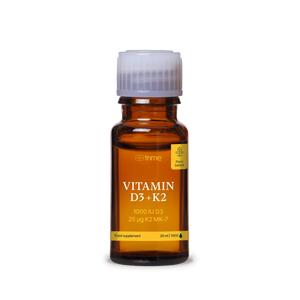
At Trime, we therefore chose MenaquinGold®, a patented raw material obtained by fermentation, which guarantees these properties. The higher price of our raw material is not just marketing. It is a direct guarantee of uncompromising purity, safety and maximum usability for the human body.

Key takeaways
The K2 MK-7 label is not enough: the same wording on a label can hide major differences in purity, absorption and production method.
The shape of the molecule is key: only the all-trans configuration with its linear shape is active and fits exactly into the relevant proteins [2].
Chemical synthesis vs. fermentation: synthetic vitamin K2 is made using organic solvents, while natural fermentation provides a practically 100% all-trans form [4].
The problem of inactive isomers: cis isomers, formed mainly during chemical synthesis, have only 1% of the biological activity of the all-trans form [2].
Support for bones: vitamin K contributes to the maintenance of normal bones. Why vitamins K2 and D3 matter for bones is explained in How to Prevent Osteoporosis.
MenaquinGold® as a guarantee: at Trime, we use a fermented raw material that guarantees a 100% all-trans configuration of K2 MK-7.
Sources:
[1] Schurgers L. J., Teunissen K. J. F., Hamulyák K., Knapen M. H. J., Vik H., Vermeer C. Vitamin K-containing dietary supplements: comparison of synthetic vitamin K1 and natto-derived menaquinone-7. Blood, 2007; 109(8):3279–3283. https://doi.org/10.1182/blood-2006-08-040709
[2] Lal N., Berenjian A. Cis and trans isomers of the vitamin menaquinone-7: which one is biologically significant? Applied Microbiology and Biotechnology, 2020; 104(7):2765–2776. https://doi.org/10.1007/s00253-020-10409-1
[3] Baj A., Wałejko P., Kutner A., Kaczmarek Ł., Morzycki J. W., Witkowski S. Convergent Synthesis of Menaquinone-7 (MK-7). Organic Process Research & Development, 2016; 20(6):1026–1033. https://doi.org/10.1021/acs.oprd.6b00037
[4] Szterk A., Zmysłowski A., Bus K. Identification of cis/trans isomers of menaquinone-7 in food as exemplified by dietary supplements. Food Chemistry, 2018; 243:403–409. https://doi.org/10.1016/j.foodchem.2017.10.001


